
Newaygo County Parole and Probation
Michigan Department of Corrections Field Operations Administration supervises state parolees and felony probationers. The Michigan Parole Board is the sole state felony paroling authority. A court, not the Board, orders probation. Neither category covers every person who leaves Newaygo County Jail, so the judgment and custody history matter.
Parole follows a prison term. The person has left secure MDOC custody, but the sentence continues under community supervision. Probation is a court-ordered alternative or follow-on status. It can begin after county jail, after a suspended jail term, or without any jail or prison stay. The public record must be read without treating those paths as interchangeable.
| Point | Parole | Probation |
|---|---|---|
| Who orders it | Michigan Parole Board after an MDOC prison sentence | Sentencing court in the criminal case |
| Custody meaning | Release from prison into supervision | Community supervision that may or may not follow confinement |
| Public check | OTIS Parolees status, Date Paroled, and supervision location | OTIS Probationers status plus the signed judgment or order |
| Completion | Discharge from MDOC authority | Court or MDOC supervision discharge, as the case record shows |
- Parole
- Conditional release from state prison while MDOC authority continues.
- Probation
- Court-ordered supervision in the community, sometimes with a jail component.
- Discharge
- The end of the applicable MDOC supervision or sentence jurisdiction shown in the record.
- Absconder
- A person whose supervision remains active but whose whereabouts are reported unknown.
Verify Newaygo County Supervision
The Offender Tracking Information System, or OTIS, is the main public lookup for people under MDOC jurisdiction. It includes current prisoners, parolees, felony probationers, interstate compact cases, listed absconders, and people discharged from MDOC supervision during the public display period. It excludes jail-only sentences and routine unsentenced county custody.
A strong match uses the six-digit MDOC number. When only a name is known, compare the date of birth, aliases, sentencing county, sentence entries, and current status. A photograph alone is not enough. Then compare OTIS with the Newaygo court judgment because probation arises from that court record.
- Open OTIS, acknowledge its terms, and search by MDOC number when available. Otherwise use last and first name with identifying filters.
- Select Parolees, Probationers, Parole Absconders, or Probation Absconders when the expected status is known. Use All if the stage is uncertain.
- Open the matching profile. Confirm identity, current status, sentence county, Date Paroled when shown, and the supervision location.
- Use MiCOURT Case Search to read the judgment, probation order, sentence, and later case events. Search both the Newaygo District Court and Newaygo Circuit Court when a felony moved between them.
- Contact the field office shown on the public profile if the status or assigned location needs confirmation or correction.
The full jail-release and court-record path appears with the Newaygo County released-inmate search. It helps distinguish a local release followed by probation from a state-prison release followed by parole.
Note: OTIS absence does not prove that Newaygo County supervision never existed because the system has scope and display limits.
Newaygo County Supervision Office
The MDOC Region 4 directory identifies a local parole and probation office in White Cloud. Region 4a operations run through Reed City. The office route is more useful than a general state contact when the public OTIS profile names Newaygo as the supervision location.
Newaygo County Parole/Probation Office
1018 Newell
P.O. Box 707
White Cloud, MI 49349-0707
231-689-7250
Region 4a Operations
301 W. Upton Avenue
Reed City, MI 49677
231-832-6179
The office can address the accuracy of a public supervision entry or identify the correct public route. It should not be asked to disclose private case details or individual conditions that do not appear in a public record. Give the MDOC number and explain the precise field in question.
The official MDOC office directory shows how supervision offices are organized. The image below helps identify the statewide directory used to reach the Newaygo listing.
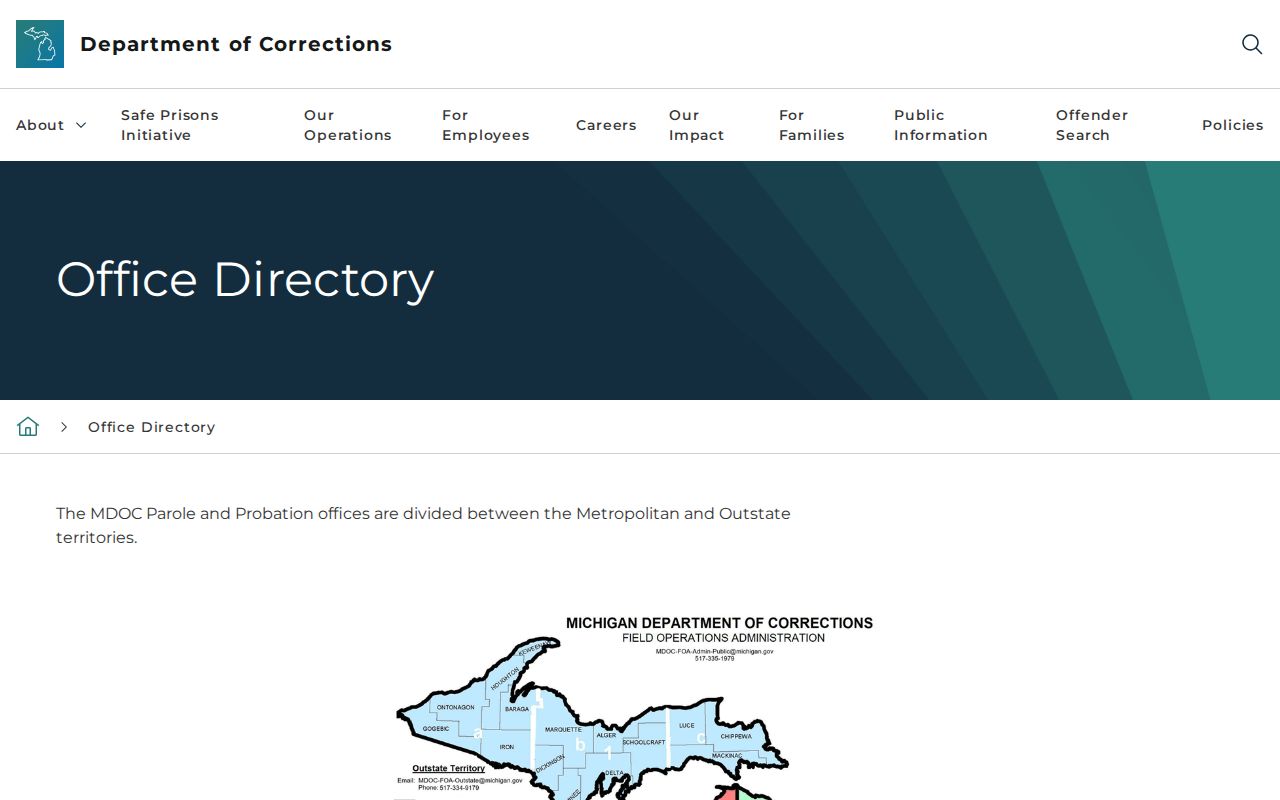
Use the directory entry that agrees with the supervision location on the matched OTIS profile.
Newaygo County Absconder Status
OTIS has separate Parole Absconders and Probation Absconders filters. An absconder entry means supervision remains active and MDOC reports that the person is out of compliance or that the person’s location is unknown. It is not a discharge. It also does not, by itself, prove that a separate public warrant exists.
For public verification, record the exact OTIS label and access date. Check the court docket for related violation or warrant events, but do not infer a warrant from the absconder label alone. Newaygo County did not publish a separate county absconder list in the research sweep. If a person knows an absconder’s whereabouts, MDOC directs reports to local law enforcement or its Absconder/Escapee Tip Line at 517-755-0855.
Newaygo County Parole Decisions
Parole eligibility, a favorable decision, and physical release are three separate stages. Under MCL 791.234, an indeterminate-sentence prisoner generally reaches Board jurisdiction after the minimum term, with credits only where the law allows them. Truth-in-sentencing cases serve the judicial minimum before eligibility. Some life sentences are not parole eligible, while other life cases follow detailed rules and exceptions in the statute.
The Board’s risk standard appears in MCL 791.233. A positive decision then moves to the Parole Release Unit, which documents the parole date, term, conditions, and transition. MDOC reports a minimum 28-day period between a release decision and physical release. A grant notice is therefore not proof that the person has left prison.
MDOC says ordinary consideration generally starts about six months before the eligibility or reconsideration point, and a Board member commonly conducts the interview by secure video. The process can end in a grant, denial, pre-release suspension, or a documented deferral while a suitable placement or treatment plan is developed. After release, a violation can lead to revocation. These are distinct stages. The individual notice, later OTIS status, and Date Paroled should agree before a Newaygo County prison release is treated as complete.
Possible stages include grant, denial, pre-release suspension, later revocation, or a placement-related deferral when documented. OTIS can show the later public status and Date Paroled. For a pending release estimate, consult the Newaygo County projected release page.
Note: A parole date should be verified in OTIS after release processing, since a Board decision alone does not establish physical departure.
Newaygo County Supervision Discharge
Discharge is the key end point for MDOC supervision. A parolee is outside prison but still serving the sentence under state authority. A probationer remains bound by the court order and supervision terms. When OTIS reports Discharged, it ordinarily indicates that MDOC jurisdiction has ended, subject to the profile’s sentence-level fields.
Read the profile-level current status with each sentence block. Record the discharge date and reason when shown. OTIS keeps discharged profiles public for three years after supervision discharge unless a set-aside or another law changes public access. An older absence does not erase the underlying court judgment or prove that supervision did not occur. The sentencing court is the right source for a judgment-based error, while the supervising office handles a public supervision-status concern.
Newaygo County Reentry Referrals
The Newaygo County Jail names local service partners on its programs page. They include Newaygo Community Education, Forgotten Man Ministries, individual alcohol and drug counseling, and Newaygo Community Mental Health. The county also reports mental-health emergency access within the jail.
Those facts describe in-custody services. They do not promise a place in a community program after release. Before a Newaygo County probation or parole transition, ask the jail or provider whether a referral was made, whether records can follow the person, and whether a continuity appointment exists. Supervision office reporting and a treatment referral are also different duties, so each should be confirmed with the source responsible for it.
Correct Newaygo County Supervision Records
The named White Cloud office gives Newaygo County residents a local correction path. If OTIS assigns the wrong supervision location or lists a disputed absconder status, contact the Newaygo office with the MDOC number, the field as displayed, and any court order that supports the correction. Region 4a in Reed City is the operational chain if the directory points there.
Judgment and sentence errors take another route. MDOC instructs users to contact the sentencing court because OTIS is corrected when the court directs a change. General OTIS accuracy concerns may be sent to correctionsinfo@michigan.gov. Separating court-source data from supervision-office data prevents a request from being sent to an office that lacks authority to change it.